Bankroll Management — The Foundation of Smart Play
Before you even load Ice Fishing, the single most important decision you will make is how much money you are prepared to spend during your session. This is your session bankroll, and it should be an amount you can afford to lose entirely without it affecting your daily life, bills, or financial obligations. Once you have set this figure, commit to it absolutely — no exceptions, no top-ups, no "just one more spin" after the budget is gone. This commitment is the difference between recreational gambling and problem gambling, and it applies regardless of your experience level or the size of your bankroll.
A practical rule of thumb is to divide your session bankroll into 30 to 50 individual betting units. If your bankroll is $100, for example, each bet should fall somewhere between $2 and $3.30. This division ensures you have enough runway to weather the inevitable dry spells between bonus triggers and gives the game's variance room to work in your favour over a meaningful number of rounds. A bankroll divided into only 10 or 15 units is dangerously thin — a short losing streak can wipe it out before the game has had a chance to produce any bonus triggers. At 30 to 50 units, you have a statistical cushion that allows the natural rhythm of the game to play out without your bankroll evaporating after a handful of unfortunate spins.
If you hit a substantial win during the session — say, a Huge Reds bonus that doubles or triples your starting bankroll — consider withdrawing a portion of that profit immediately. Locking in gains prevents the common trap of "playing back" everything you have won. A simple rule is to withdraw half of any significant win and continue playing with the remainder. This way, you guarantee a positive outcome from the session regardless of what happens next. The most disciplined players set both a loss limit and a win target before each session and walk away the moment either threshold is reached. This dual-limit approach removes emotion from the decision to stop playing, which is exactly when emotions are most dangerous and most likely to lead to regrettable choices.
Australian players should also be aware of the deposit-limit tools available at most licensed operators. These tools allow you to set daily, weekly, or monthly caps on how much money you can add to your casino account. Setting a deposit limit that aligns with your overall gambling budget adds a structural safeguard on top of your personal discipline. Even the most well-intentioned player can have a moment of weakness at 2 a.m. after a losing session; a deposit limit ensures that moment of weakness has a hard ceiling. Think of these tools as seatbelts — you hope you never need them, but having them in place is an act of basic self-care that costs nothing and could save you a great deal.
Three Betting Approaches for Ice Fishing
| Approach | How It Works | Best Suited For | Risk Level |
|---|
| Conservative | Minimum or near-minimum stakes on every spin; prioritise session length over individual win size | New players, small bankrolls, extended entertainment sessions | Low |
| Balanced | Moderate stakes with a slight bias toward covering bonus-triggering segments alongside standard Leaf bets | Experienced players comfortable with medium variance | Medium |
| Aggressive | Larger stakes concentrated on segments with the highest payout potential; accepts shorter sessions in exchange for bigger individual wins | Players with substantial bankrolls who are comfortable with rapid swings | High |
No single approach is objectively "better" than the others — the right choice depends entirely on your personal bankroll, risk tolerance, and what you want from the session. A conservative player might enjoy 90 minutes of steady action on a $50 bankroll, while an aggressive player might burn through the same amount in 15 minutes but land one massive bonus payout in the process. Both outcomes are valid; what matters is that you chose your approach deliberately rather than drifting into it by accident. Intentionality is the defining characteristic of strategic play.
The conservative approach is the safest starting point for Australian players new to Ice Fishing. Minimum stakes allow you to observe the game's rhythm over many spins, develop a feel for the bonus trigger frequency, and build confidence in your understanding of the interface — all without putting meaningful money at risk. The balanced approach works well for players who have already spent time in the demo and want to increase their engagement without taking on excessive risk. It involves moderate bet sizes and may include covering multiple segments per spin to increase the chance of any return, even if the individual payouts are smaller. The aggressive approach is reserved for players who fully understand the game's variance, have a bankroll large enough to absorb significant swings, and are psychologically prepared for the possibility of a short, unprofitable session that ends well before they planned.
Regardless of which approach you choose, never switch approaches mid-session in response to results. If you started conservatively and hit a losing streak, the temptation to switch to aggressive betting "to make it back" is powerful and almost always counterproductive. Stick with your chosen approach for the entire session. If you want to try a different approach, do it in a fresh session with a fresh bankroll and a clear head. Mixing approaches within a single session almost invariably means you are reacting emotionally rather than thinking strategically, and emotional decisions in casino games are reliably expensive.
Analysing the Bonus Rounds Strategically
Risk Versus Reward Across All Three Tiers
| Bonus Round | Multiplier Range | Estimated Trigger Frequency | Strategic Takeaway |
|---|
| Lil' Blues | 3x – 100x | Most frequent of the three | Provides consistent supplementary wins; ideal for padding a conservative bankroll strategy over many rounds |
| Big Oranges | 4x – 200x | Moderate frequency | Offers the best balance of trigger rate and payout ceiling; the "sweet spot" for most sessions and most players |
| Huge Reds | 10x – 500x | Least frequent | High-impact but rare; treat it as a welcome surprise rather than something to plan your entire session around |
Understanding the relationship between trigger frequency and multiplier range is essential for setting realistic expectations. Lil' Blues will appear more often than the other two bonuses, but its maximum of 100x means it rarely produces session-defining results. Big Oranges hits a genuine sweet spot — its 200x ceiling can meaningfully change the trajectory of a session, and its moderate frequency means you have a reasonable chance of triggering it within a typical playing window. Huge Reds is the aspirational tier — the one you dream about but do not plan around. Building your entire strategy around waiting for Huge Reds is a recipe for frustration, because its rarity means you could play for hours without seeing it. The healthiest mindset is to enjoy every bonus trigger for what it is, appreciate the bigger ones when they arrive, and never feel entitled to any specific outcome.
What to Keep in Mind During Bonus Rounds
- The fish size is determined by the RNG, not by player action — once the bonus round triggers, the outcome is already decided by the random number generator. The gradual reveal of the fish is a presentation mechanic designed to build suspense; it does not reflect a real-time decision process that you can influence. No amount of timing, wishing, or button-pressing will change the size of the fish. The result was sealed the moment the wheel stopped on the Fish Bonus segment.
- The visual reveal is entertainment, not information — watching the fish emerge piece by piece feels interactive and emotionally engaging, but no amount of "willing" a bigger fish will change the result. Enjoy the spectacle for what it is and accept the outcome calmly, regardless of size. This mindset protects you from the frustration that comes with expecting to control something that is fundamentally random. The reveal is a show; the outcome is mathematics.
- Bonus segment density on the wheel determines trigger rates — the number of Fish Bonus segments relative to the total 53 segments dictates how often you enter a bonus round. This ratio is fixed and cannot be altered by bet size, timing, or any other player action. Larger bets do not make bonuses more likely; they only make the payout larger when a bonus does occur. Understanding this distinction prevents a common misconception that bigger bets "attract" bonuses.
- Predicting which bonus tier will appear is impossible — there is no way to know in advance whether a Fish Bonus trigger will lead to Lil' Blues, Big Oranges, or Huge Reds. Each trigger is an independent random event governed by the same certified RNG that controls every other aspect of the game. Strategies, websites, or tipsters that claim to predict bonus tiers are offering fiction, not fact.
Common Mistakes That Cost Players Money
- Chasing losses by increasing stakes — after a series of non-winning spins, the temptation to raise your bet "to make it back faster" is powerful and almost always destructive. Each spin is independent, and a bigger bet does not improve your odds of hitting a winning segment. All it does is drain your bankroll faster, shortening your session and reducing the number of opportunities you have to trigger a bonus. This is the single most expensive mistake a player can make, and it applies to every casino game ever created, not just Ice Fishing. The urge to chase is a natural human response to loss; recognising it and refusing to act on it is the most valuable skill you can develop as a casino player.
- Playing without a predetermined budget — entering a session with a vague sense of "I'll stop when I feel like it" is a recipe for overspending. Without a hard limit, emotional momentum — both positive and negative — will dictate your decisions instead of rational planning. A winning streak will make you feel invincible and encourage you to keep playing longer than you should, believing your luck will continue. A losing streak will trigger desperation and the compulsion to win it back. Both scenarios end badly without a pre-set budget providing a clear stopping point.
- Believing in hot and cold streaks — the human brain is wired to detect patterns, even where none exist. This is an evolutionary feature that served our ancestors well on the savannah but serves modern casino players poorly. A run of five consecutive Leaf-segment wins does not mean a bonus is "due," and a dry spell of 20 spins without a bonus does not mean the next spin is more likely to trigger one. Every spin is mathematically independent of every other spin. The RNG has no memory, it does not track your recent results, and it does not care about your feelings of being "overdue" for a win.
- Ignoring Leaf segments entirely — some players focus exclusively on bonus triggers and dismiss Leaf wins as insignificant or unexciting. In reality, Leaf payouts — especially when amplified by the up-to-10x multiplier — form the bread-and-butter income of a typical session. They keep your bankroll alive between bonus triggers, extend your playing time, and can produce surprisingly satisfying results when a multiplier lands on a well-placed bet. Undervaluing them leads to unrealistic expectations, chronic frustration, and a skewed understanding of how the game's economy actually works.
- Assuming demo patterns predict real-money outcomes — strategies or "systems" developed during demo play are based on a finite sample of spins that has no predictive power over future real-money results. The RNG resets with every spin, and demo sessions are statistically no different from real ones in terms of outcome distribution. A system that "worked" in 50 demo spins is not a system — it is a coincidence. If you approach real-money play with confidence rooted in demo results rather than genuine understanding, you are setting yourself up for an expensive lesson in probability.
Pre-Session Checklist — Six Steps Before You Spin
- Set your session bankroll — decide the exact dollar amount you are prepared to spend and transfer only that amount into your casino account or earmark it mentally if the funds are already deposited. This number is your absolute ceiling for the session, and crossing it should feel as unthinkable as walking through a red traffic light. Write the number down if it helps you commit to it.
- Calculate your unit bet size — divide your session bankroll by a number between 30 and 50. This gives you the maximum stake per spin. For a $100 bankroll, that means bets of $2 to $3.30. For a $200 bankroll, bets of $4 to $6.70. Write this number down or set it as your default stake in the game interface so you do not have to recalculate during play, when cognitive load and emotional pressure can cloud your judgement.
- Choose your betting approach — decide in advance whether you will play conservatively, with a balanced spread, or aggressively. Write it down or say it out loud if that helps you commit. The act of articulating your approach makes it more concrete and harder to abandon when emotions start running during the session. A pre-committed plan is always smarter than a plan made up on the fly in the heat of play.
- Review the in-game paytable — before placing your first bet, open the paytable within Ice Fishing's interface. Confirm the payout ratios for each segment type and verify the multiplier ranges for all three bonus rounds. This takes 30 seconds and ensures you are playing with full information rather than assumptions that may be incorrect or outdated.
- Set a win target — decide at what profit level you will stop playing. A common benchmark is 50% to 100% of your starting bankroll. If you start with $100 and reach $150 or $200, you walk away with a guaranteed profit. This target gives your session a clear endpoint on the positive side, preventing the "one more spin" mentality that often turns a winning session into a losing one. Walking away a winner is a skill, and win targets make it easier to practise.
- Set a loss limit — this is your session bankroll itself. When it hits zero, the session is over. No reloads, no deposits, no exceptions. If the game or your casino operator offers a session-time reminder or a loss-limit tool, activate it as an additional safeguard. The loss limit is the most important number in your entire strategy, because it is the one that protects you from genuine financial harm.
Playing Responsibly — A Non-Negotiable Priority
Ice Fishing is designed to be entertainment, not a source of income. The mathematical structure of the game guarantees that the house holds a long-term advantage, which means that over a sufficient number of spins, the average player will return less money than they wagered. This is not a flaw, a conspiracy, or a secret — it is the fundamental reality of every casino game ever created, from the grandest baccarat tables in Macau to the humblest pokie machine in a suburban RSL. Acknowledging this upfront is the first and most important step toward maintaining a healthy relationship with gambling.
Accepting this reality allows you to enjoy Ice Fishing for what it genuinely offers: fast-paced excitement, stunning production quality, the warmth of a shared live experience, and the occasional thrill of a big bonus catch. The value proposition is the entertainment experience itself, measured in enjoyment rather than profit. Approach it the same way you would approach buying a cinema ticket, attending a football match, or taking a trip to the races — you are paying for an experience, and any winnings are a bonus, not an expectation. When you frame it this way, every win becomes a pleasant surprise rather than a relief, and every loss becomes the cost of entertainment rather than a personal failure.
Every reputable Australian-facing casino provides self-limitation tools, including deposit limits, session time limits, cooling-off periods, and self-exclusion options. Use them proactively, not just reactively. Setting a deposit limit before you have ever had a problem is wise; waiting until you are already in trouble is like putting on a seatbelt after the car has started skidding. These tools are not signs of weakness or admissions of a problem; they are signs of maturity, self-awareness, and a clear-eyed understanding of how casino games work. Even professional advantage gamblers — people who make their living from games where skill genuinely matters — use rigid bankroll management tools. Recreational players have even more reason to rely on them, because the games they play are mathematically designed to favour the house over any meaningful timeframe.
If you ever feel that your gambling is becoming difficult to control, that you are spending more than you can afford, that you are chasing losses or playing to escape emotional distress, or that the activity is causing stress, anxiety, or conflict rather than enjoyment, reach out for support. Organisations such as BeGambleAware and GamStop provide free, confidential assistance to players who need it. There is no shame in asking for help — the shame lies in recognising a problem and choosing to ignore it. No strategy, no system, no amount of "experience," and no article on the internet can guarantee a profit in Ice Fishing or any other casino game. Play within your means, enjoy the show, and step away when the fun stops. That is the only strategy that truly matters.
Start with the game mechanics
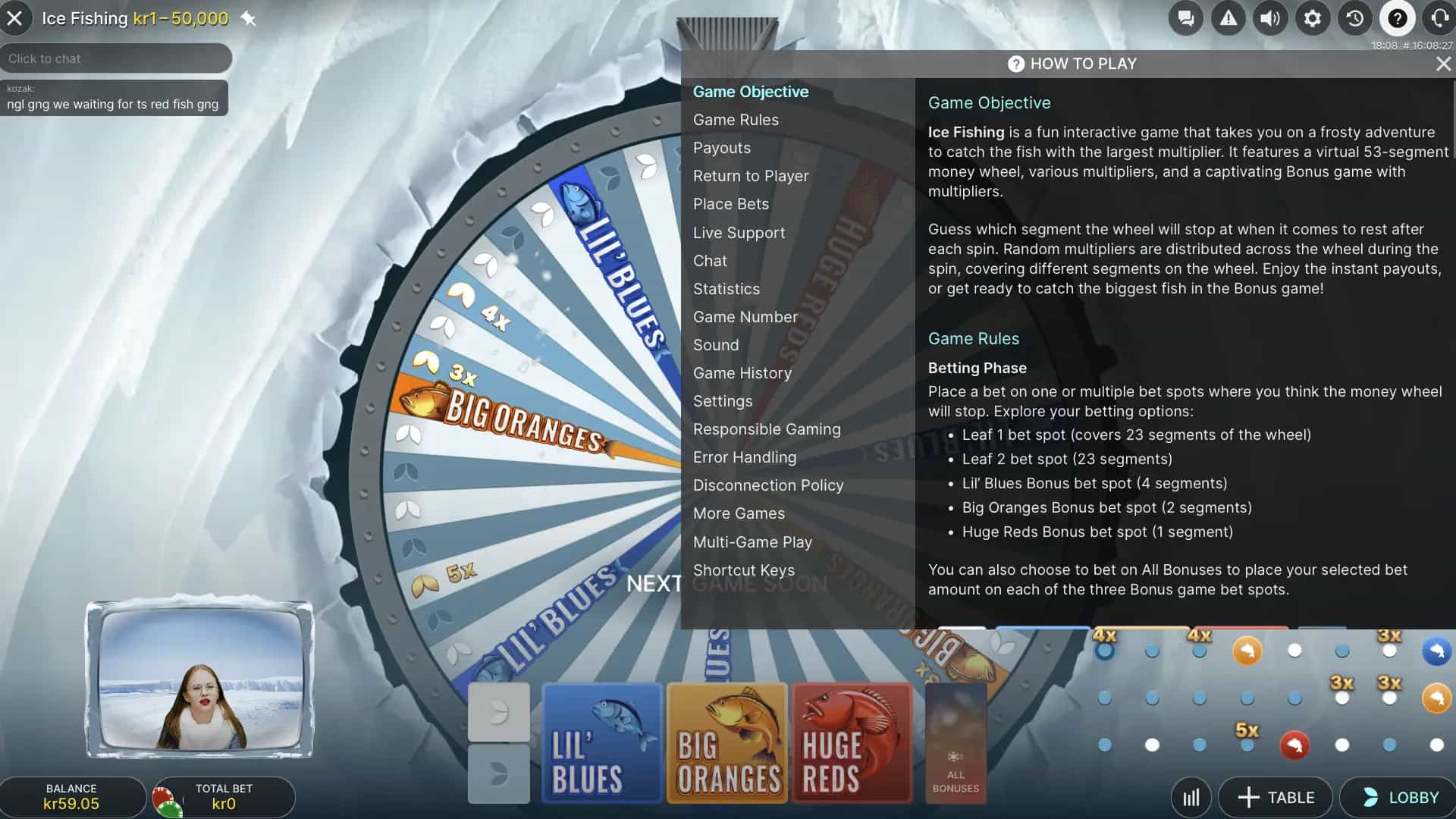
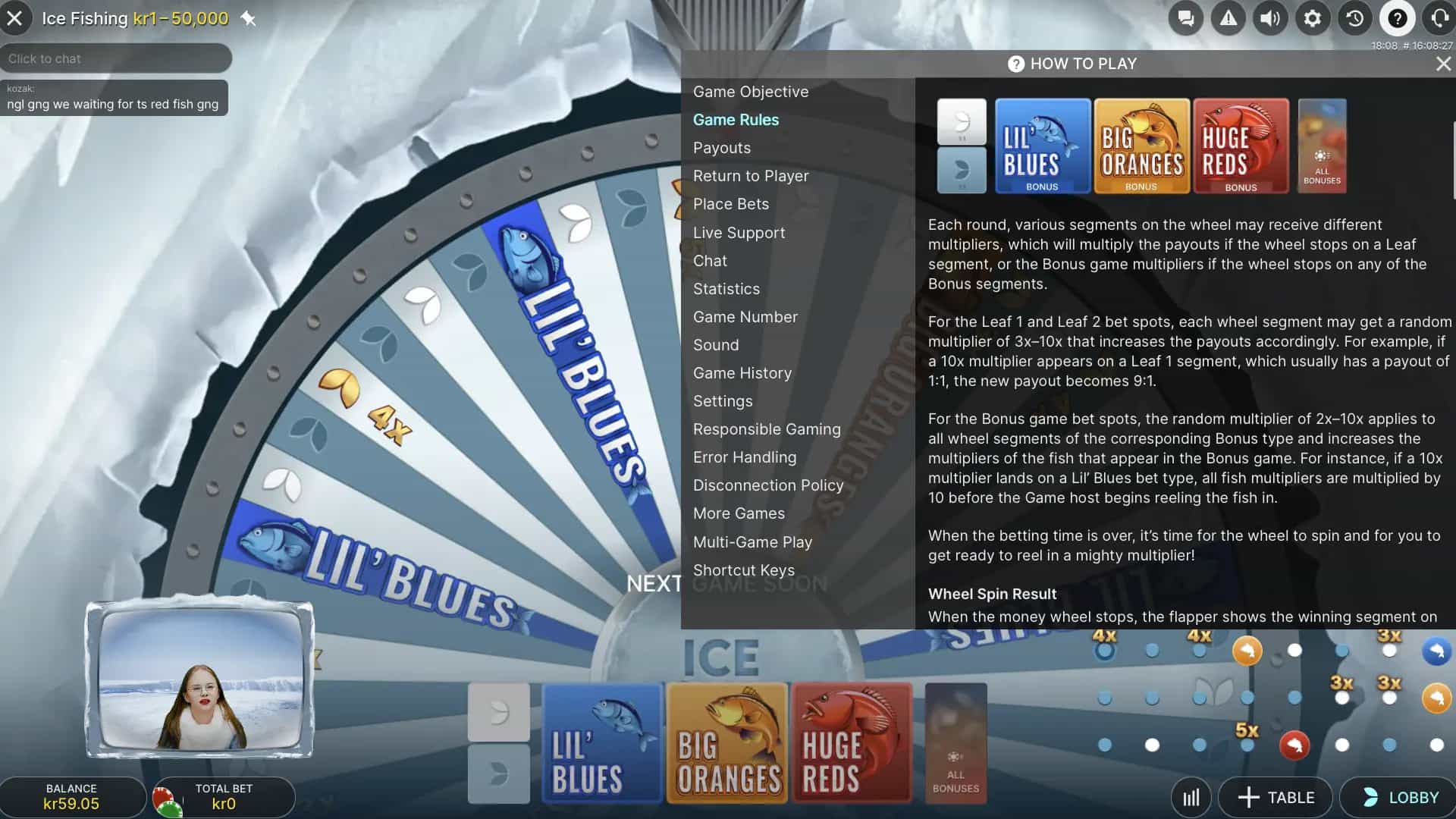
Ice Fishing is a live speed game show built around a virtual wheel with 53 segments. Some wheel segments may receive random multipliers of up to 10x, while the game also features three bonus options: Lil' Blues, Big Oranges and Huge Reds. A sensible strategy begins with understanding those choices rather than searching for a system that promises a particular result.
No betting pattern can remove the uncertainty from each round. The useful decisions are the ones you control: how much to spend, how long to play, which available choices fit your comfort level and when to stop. That approach will not guarantee a win, but it can make each session easier to follow.
Set the bankroll before playing
Choose a fixed session bankroll that can be spent without affecting everyday expenses. Treat it as the complete limit for that session, not the first amount in a longer run. Dividing it into smaller units can help you see how many rounds your chosen stake may cover.
Keep the starting stake modest enough to leave room for several rounds. Large changes after a loss can use the bankroll quickly, while sharp increases after a win can return those funds just as fast. A steady stake is usually easier to track than an improvised sequence.
Use both money and time limits
A spending cap answers how much you can use. A time limit answers how long you want the session to last. Set both in advance. When either limit is reached, finish the session rather than extending it to chase a result or continue a winning run.
Compare the three bonus choices calmly
Lil' Blues, Big Oranges and Huge Reds are the three named bonus game options. Their presentation may encourage quick decisions, so identify the available choices before committing a stake. Pick according to the level of variation you are comfortable seeing, not because a previous round appeared to create a pattern.
Random multipliers of up to 10x may also be applied to wheel segments. Their appearance does not turn a segment into a certainty. Consider them part of the round's variable mechanics rather than a signal to increase the next stake.
Avoid common session mistakes
- Chasing losses: Increasing stakes solely to recover earlier spending can exhaust the session bankroll.
- Assuming a streak must end: Earlier wheel results do not provide a dependable instruction for the next choice.
- Changing plans mid-session: Repeatedly moving the spending or time limit removes the value of setting one.
- Focusing only on multipliers: A highlighted multiplier is a game feature, not a promised return.
- Playing too quickly: The speed-game format makes it important to pause and check the remaining bankroll.
Use a simple pre-session checklist
- Set a total bankroll and a firm stopping point.
- Choose a starting stake that allows room for multiple rounds.
- Learn the wheel and the three bonus names before committing funds.
- Keep stake changes deliberate rather than emotional.
- Stop when the money limit or time limit is reached.
The strongest Ice Fishing strategy is not a prediction system. It is a clear plan for handling the choices that remain under your control while enjoying the game's fast pace and bonus mechanics.
Questions and answers
How many segments are on the Ice Fishing wheel?
The main game uses a virtual wheel with 53 segments.
What are the Ice Fishing bonus options?
The three bonus game options are Lil' Blues, Big Oranges and Huge Reds.
Can wheel segments receive multipliers?
Yes. Random multipliers of up to 10x may be applied to wheel segments.
Play Ice Fishing
Last reviewed: 02 September 2026, 21:12 UTC.